




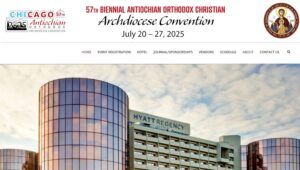
THURSDAY, JULY 24, 2025
Address of Metropolitan Saba to the General Assembly of the 57th Biennial Archdiocese Convention
His Eminence Metropolitan Saba
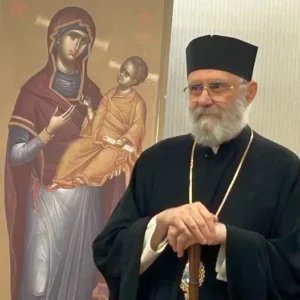
Keynote Address by His Eminence Metropolitan Saba at the
General Assembly of the 57th Biennial Archdiocese Convention
Chicago, Illinois, July 24, 2025
“All things work together for good for those who love God” (Romans 8: 28).
Your Graces the Bishops; reverend members of the clergy; esteemed members of the Board of Trustees; heads of departments; members of The Order of St. Ignatius of Antioch; ladies of the Antiochian Women; our dear young adults; members of Teen SOYO; members of parish councils; and all our beloved and faithful people of our God-protected Archdiocese:
Excuse me for not talking about the theme of this convention[1] because of what is happening in the Middle East. Many of our parishioners in our Archdiocese ask me about the spiritual and theological attitude toward suffering in general. I came back to the theme of another convention which is a quote from Romans: “All things work together for good for those who love God” (8:28). I want to start with this verse today because we, as a church, should counsel and support the wounded and suffering people.
All of us here love God—or at least, that is what is expected of us. The one who loves God emulates Him and, as he entrusts his life into His hands, strives to be after God’s own heart. He accepts all that happens to him or her with contentment and faith, believing it to be for his or her benefit and salvation.
This theme is profoundly deep—and at the same time difficult for anyone who has not wholly surrendered their life to God. Facing the self and subjecting it by replacing our will with the will of God requires constant spiritual struggle that consumes the years of our lives, with the hope that the words “Thy will be done” might truly come to life within the depths of our souls.
I was seized by longing after finishing my first year of university to study theology. I secretly traveled to Lebanon without informing my parents and told them from there, that I had left university to study what my heart desired. My father followed me in a fury and brought me back by force—after the abbot of the monastery had asked me to first finish my university degree. So I returned obediently, but with anger.
After finishing university, I began my theological studies. Then I discovered a great difference in myself between my first and second departures. I also realized how much life experience I had gained through university, along with my intensive involvement in Church life through the Orthodox Youth Movement. These gave me the ability to better understand theology, relate it to pastoral care, and present it in a smooth and connected way with real life.
Was what happened, although against my will at the time, for a greater good or not?
Michael Lapsley is an Anglican monk from New Zealand. He served in South Africa during the time of apartheid. He resisted the regime fiercely but nonviolently. The authorities expelled him to another country. He continued his struggle and one day received a letter bomb that exploded when he opened it, costing him both arms and one eye, and leaving his body riddled with shrapnel.
He remained in the hospital for seven continuous months, followed by two more years of treatment to learn how to manage his new life. Despite his condition, he continued his advocacy. After the apartheid ended, he returned to South Africa and established the Institute for Healing of Memories —places where all South Africans of all races came together to share their pains and confessions to one another. Through forgiveness, he paved the way for healing and the liberation of souls from a horrific past. He expanded this work by establishing similar centers in many other countries.
In his book Redeeming the Past, he writes: “That [bombing] experience was a true purification of my being.” Let us listen to his words as he reflects on the very verse that I have been expanding on:
“I used to resist racial discrimination and the separation of blacks and whites with intense stubbornness. But after the incident, I began to feel a gentleness within myself and a deeper understanding of both the victim and the oppressor, so that God could use me in founding these centers.” (Adapted from themes in Michael Lapsley’s life and writings, especially Redeeming the Past: My Journey from Freedom Fighter to Healer, 2012.)
How does the believer receive and interact with evil? How does one transform suffering into something for their own good? These are questions every believer faces. Many people reject the idea of God’s existence because of the immense and diverse forms of evil in the world. Others have discovered God precisely through these evils. And many others have found meaning and purpose in their lives after passing through great suffering.
Yet many have died without knowing the answer—but their loved ones, after their passing, have come to recognize the good that came through their trials.
The Book of Proverbs says: “For whom the Lord loves He reproves, even as a father corrects the son in whom he delights” (Proverbs 3:11–12).
The word “reproves” (or “disciplines”) as rendered in the original Greek paideia conveys the meaning of nurturing and training a child through the use of instruction, counsel, rebuke, or discipline. Some modern translations even render it as “rebukes” instead of “disciplines.”
So, “discipline” here means refinement. It is a tempered form of reproof or punishment meant for correction.
These two verses from Proverbs speak of God’s discipline as part of His paternal love. The fundamental idea is that divine discipline is not a harsh punishment but a means of guiding the person toward the right path. In the religious context, divine discipline is seen as an expression of God’s love, as He corrects those whom He loves, just as a father does with a child, to make him wiser and more upright.
In this positive context, Christians view the trials they face with full trust in God, who grants them strength and inner peace to endure them. This is also the task of spiritual fathers—to strengthen and comfort their spiritual children.
For example, Elder Ephraim of Arizona, in comforting one of his spiritual children, wrote: “How much a person loses when he suffers and forgets his sonship and does not realize that he is being disciplined as a child of God.” (Counsels from the Holy Mountain. p. 13) To another, he encouraged: “Trials come to teach us how to become bearers of hardship, trained warriors, followers of Christ who was crucified for us, brothers of all the saints who walked the thorny path of the Cross… and believers who keep the holy commandments, facing trials caused by the world, the devil, and the flesh” (page 19).
Are we ready to give thanks for both joys and sorrows, for health and illness, for peace and war, and so on? Are we ready to give thanks for everything? It is from thanksgiving that the journey begins—towards accepting what happens to us with faith, courage, and surrender to God. From there, we draw strength, ability, and wisdom to transform evil into good for ourselves and for others.
Complaining and grumbling increase our feelings of frustration and despair. They darken our vision, making the suffering we endure even heavier on us and more damaging to our souls.
Let us begin, then, with thanksgiving. If we look at the reality of our Archdiocese, we will find many things for which we can thank God and rejoice in with a positive spirit. At the same time, we will also find many things to complain about and criticize with a negative spirit. Our Christian faith calls us to choose the former. So let us begin with the positive aspects and ask ourselves how to develop an attitude of faith that fosters them, and how to avoid the negative outlook that is often fueled by our impure passions.
*******
Many are concerned with financial matters in the Archdiocese and complain about what they call a “loss of trust.” Three years ago, we began a financial audit covering all aspects of the Archdiocese. During this conference, you will hear the audit report of the past year prepared by a specialized company, and you will have the chance to discuss it with the professionals. This is a good thing.
The auditing journey began at the Archdiocesan level, not to stop there, but to gradually extend to all departments, institutions and parishes. Our goal is to manage our income and expenses with utmost accuracy, transparency, and effectiveness. The auditing process will reach all our churches and institutions.
Will we thank God for this and appreciate the efforts of those undertaking it, or will it pass without us giving it any importance? Will we volunteer to involve our parish in it, or will we place roadblocks to prevent the audit from reaching us?
We thank God for our youth who dedicate themselves to the priesthood and for the theological institutions available to them that offer necessary education and formation. We are serious in this regard. We have begun personally following up with them and providing what is needed so that their pastoral service in the future may be more effective. But we are still in need of more men willing to serve.
Will we continue to complain about the shortage and wait for those inclined toward the priesthood to come to us, or will we work to cultivate and nurture priestly vocations in the hearts of our young people? And how?
Our work with the youth still exists, but it weakens here and there and remains routine and uncreative—at least not to the desired degree—while a thirst for authentic spiritual life among the youth continues to grow, along with the challenges they face—spiritually, morally, economically, and in terms of values.
Many are drifting away from church life because the Church does not speak to them. How do we help them break free from the isolation of the parish and move into the wider embrace of the Archdiocese? This requires reflection and dialogue. Our youth need to exchange experiences, build friendships, live in community with one another, and discover the role of the Eucharist in their lives and relationships.
What are we doing to communicate with our youth and help them realize that the Church is their Church? We have superb youth—they thirst for the springs of Orthodox spiritual life and are not ashamed to say it. But what are we offering them now? Some activities they no longer need the Church to access. (The same activities that the world is offering them.)
Why don’t we listen to them enough? Why do we insist on remaining clergy and laity who simply observe them, allowing only what we decide for them? Why do we hinder the work of the Holy Spirit in them? “It is enough to listen to their cries to understand what gnaws at them from within. Let us share in their joys and what inspires them, so that we might discover the best ways to reach their hearts” (Raymond Rizk).
In my last meeting with the bishops of the Archdiocese and the archepiscopal vicars, it was revealed that in our Sunday schools, the highest rate of attendance among our children does not exceed 50%. Shouldn’t our ambition be 100%? How do we achieve that?
We thank God that the vast majority of our parishes and missions are blessed with the presence of a priest who provides sacramental and liturgical services. We also thank Him for the launch of the voluntary diaconal ministry, which aims to ensure pastoral care for all age groups within the parish. But will we encourage our young people to embrace this ministry, or will we continue to merely observe?
We must understand that continuing traditional pastoral care that relies on a single priest—or at best, two—is no longer sufficient to provide optimal pastoral care to our faithful. The diversity of pastoral needs in our time, the increasing challenges to the faith, and the wide geographical spread of our parishioners’ homes, coupled with the long distances and time required for clergy to reach these homes, all demand that we develop and promote voluntary diaconal service.
Some parishes consist of enormous numbers of families and are cared for by only one priest! One of our parishes in Montreal has 1,565 families – not individuals – and one priest! I inform you that we will hold a Deacons Symposium following the Clergy Symposium next year, and I await your support. Our vision is that each parish will have several trained volunteer deacons, each specializing in a particular pastoral service.
Many new challenges now require specialized care. We must provide social workers and counselors trained to deal with marital issues, addiction of all kinds, elder care, accompanying the dying, visiting the sick, home-based spiritual gatherings, weekly retreats, and other specialized ministries that are now more necessary than ever.
We thank God for the Missions Department. In the past, we served and followed up with new missions only once their faithful had already organized themselves. Today, we proactively seek out scattered faithful and invite them to collaborate with us in forming missions, encouraging and supporting them. Moreover, we give thanks that some of our established and thriving parishes have begun to sponsor the creation of new missions, nurturing them until they mature and become independent churches.
We no longer merely wait for a request to form a mission—we now encourage their establishment and take them under our wing until they grow and stand on their own.
We thank God for the Archdiocese’s ability to welcome many catechumens and prepare them for full membership in the Church. We are grateful to have begun standardizing this preparation process by initiating the establishment of a Catechesis Program. The first version of the required program is now ready and will be distributed to several priests across the Archdiocese to be implemented for catechumen formation throughout the upcoming year. They will provide feedback, which will help us finalize the program. The new program will be in a two-year pilot phase, during which the relevant committee will collect observations, comments, and suggestions from various parishes before establishing the final version.
One of our priests described the influx of converts as a “surge.” This requires us to be very discerning and thorough in receiving inquirers. Let us be cautious not to rejoice merely in numbers at the expense of spiritual quality (and health of our parishes).
We also look forward to soon establishing a special ministry for the newly illumined. After their baptism or chrismation, they must be accompanied spiritually and pastorally for an extended period so that they may integrate into Church life with a pure Orthodox spirit. They must experience the parish as a Eucharistic community, a true fellowship, a genuine family of Christ, and acquire the Orthodox mindset and conscience.
Orthodoxy, beloved, is not an ideology; it is a way of life, founded upon faith that has been articulated in doctrine so that it may be preserved and passed down by the faithful. There is a vast difference between doctrinal faith and ideological thinking.
In our previous convention, we stated that the infrastructure of the Archdiocese had been completed—meaning church buildings, parish houses (fellowship halls), and associated facilities—and that it was now time to begin supporting Church departments and institutions that serve in evangelical, social, and humanitarian work. This requires funding, especially in light of rising living costs, which are not matched by a corresponding increase in income. For this reason, some of our churches have begun to suffer from financial strain, resulting in a decline in spiritual services.
Now is the time to enter the realm of investment, especially real estate, in order to support and provide dignified services for Church ministry. Why are we content to invest all our funds in large financial institutions? Land and property prices are rising. Some pastoral service projects are coming to a halt due to lack of liquidity. Should we not think seriously about increasing our financial resources through other means, in addition to tithes, donations, and endowments? I brought up this issue in the previous convention as well.
There is also an increasing demand for service-oriented institutions such as schools, nurseries, and similar establishments. These typically begin small and grow over time, which is preferable. My advice to you is this: at both the Archdiocesan and parish levels, try to develop a comprehensive vision and begin with what is feasible, no matter how small. This is how we seek God’s blessing in any project. If it grows and succeeds, it will be a sign of His blessing; if not, we cancel it and move on to another initiative.
Are you aware that we currently lack designated funding for some programs that are essential to the continuity of the Archdiocese? For example:
Emergency support for priests,
Pastoral training and care for seminarians,
Provision of traveling priests for areas in need of new missions,
Launching specialized pastoral care programs.
We thank God for the few institutions that have already started to emerge. We all agree on the need for more service institutions. So why don’t we, as various Orthodox entities in the same geographical region, begin cooperating to establish such institutions—whether a school or a home for the elderly, for example? This way we pave the road toward the unity we desire, when God wills and blesses it, rather than merely talking in theoretical terms while teaching our people a spirit of division and tribalism foreign to our Antiochian tradition over the past 2,000 years.
We thank God that The WORD Magazine and Joy Magazine are still ongoing. The former has undergone a clear upgrade in layout, while the latter has started to improve and diversify. Likewise, the Archdiocese’s publications have started to be released. Today, we need to think deeply and professionally about the best ways for these tools to serve as a means of:
Strengthening the unity of thought and vision in our Archdiocese,
Reinforcing the bonds of brotherhood among us as believers, and
Deepening the connection between us and our Archdiocese, parishes, and institutions.
Yet we still face the challenge of ensuring that these publications reach all our parishes. This is an open question for discussion. I regret to inform you that many parish service leaders have shown little interest in the Archdiocese’s publications — a troubling sign.
We thank God for the archival resources that document our heritage. But we must push the Heritage Preservation Center forward. Much of our history remains locked in the pages of The WORD Magazine, which is now over 100 years old. This material needs systematic digital archiving, along with other written, visual, and oral materials documenting the history of the Archdiocese.
We also need to revive and reconstruct our Orthodox cultural traditions. Let me offer some examples:
Feast days of saints are not reflected in the celebrations of their namesakes,
The rhythm of feasts is not accompanied by the social or material expressions that affirm the feast day—apart from the Christmas tree and Easter eggs.
Where is our lived tradition, springing from our faith and Church? The Orthodox tradition includes specific foods associated with particular feast days.
We thank God for the beginning of monastic life in the Archdiocese. I ask that you accompany it with your prayers so it may grow with God’s blessing and grace.
The Monastery of the Life-Giving Trinity has begun with the Hieromonk Paul in Memphis, Tennessee.
We also hope that the arrival of the three nuns who will begin monastic life at the Antiochian Village will not be delayed.
We thank God for the Antiochian Village, the heart and reservoir of the Archdiocese for the past fifty years. May God have mercy on our father in Christ, Sayidna Philip. Tens of thousands of our children have spent their summers in its camps, and we called upon them during the last board meeting to establish a Friends of the Antiochian Village Association.
Until now, the Village does not have its own designated endowment to cover part of its maintenance and development expenses. This year, we began by allocating a small endowment for the camp.
The main chapel at the camp is no longer sufficient for the large number of people it hosts during camp sessions or conferences.
We now face the challenge of having to build a large church at the Village with a capacity of 350 to 400 people.
We also need a cemetery for the Archdiocese, where our beloved departed can be laid to rest and remembered at every Divine Liturgy, especially those offered on Saturdays for the departed.
Strengthening the Village will positively impact all aspects of the Archdiocese—beginning with the camps of each region. It is the heart that pumps blood into the arteries of the one body, especially once a women’s monastery rises upon its grounds.
We thank God that the Archdiocese is not confined to a single culture, but rather, like our American society, it is composed of multiple cultures. Would it be too much to ask that we equip our priests and acquaint them with the various cultures present among the faithful of the Archdiocese?
There are three main cultures represented among us, and alongside the primary English language, many other languages are spoken. So how do we pastor all these cultures? What kind of training do our clergy and parish councils need in order to properly minister to everyone?
We look forward to training sessions for parish council members, as well as ongoing training for our clergy.
In the meeting of the bishops, there was also agreement that the Parish Life Conferences need to be re-evaluated. The number of participants is decreasing year after year. There is a near consensus that the original goals for which these conferences were established decades ago need to be reconsidered in light of the societal and economic changes of recent years.
There are many suggestions on the table, and this calls us to study the matter thoroughly so that everything we do truly fulfills the purpose for which this work was originally created. I call upon you to study the Parish Life Conferences at the level of the regional deaneries and districts, and among both the clergy and faithful. I look forward to hearing the results of your discussions soon.
There are important questions in this regard:
If some of our activities involve significant expenses, what about the faithful who cannot afford to participate?
What do we offer them? What are the alternatives?
Not everything we examine needs to be canceled, but perhaps developed or supplemented with other necessary activities.
Lastly, and certainly not least, this important gathering of ours — the General Assembly — also needs development and restructuring. We must move beyond merely presenting reports followed by a few questions, and shift towards workshops, discussion sessions, and clear recommendations (or action plans). Otherwise, we will remain locked in a routine that weighs down the Archdiocese with stagnation and stifles creative energy.
We are a people who believe that the Holy Spirit is present and active in the Church. So why do we not allow the Spirit of God to ignite in us new initiatives, visions, aspirations, and bold efforts? I hope that by the next convention, we will come together with a renewed mindset and emerge with recommendations that shape the next two years at the level of both parishes and the Archdiocese.
Let us look together toward supporting one another, that we may prepare our souls to become a dwelling worthy of the Lord, in accordance with His saying: “If anyone loves Me, he will keep My word; and My Father will love him, and We will come to him and make Our home with him” (John 14:23).
Thus, relying on our Lord and His power, and opening ourselves to His Holy Spirit, who performs wonders and gives life, who from before the beginning “was hovering over the face of the waters” (Genesis 1:2) — we may work through Him and according to His will, walking the path of transfiguration.
As our brethren at St. Elias Church in Damascus cleaned their church up on the day following the tragic terrorist attack, and as our priests and seminarians who were on the pilgrimage to Jordan and Lebanon noticed that their church is forever adhering to the Orthodox faith in every way possible regardless of centuries of instability, war, various persecutions and martyrdom for merely carrying the name of Christ, so shall we draw from their daily witness and strength to continue witnessing to Christ in a world that masquerades without shame to the teachings of Christ and his gospel.
Drawing continuous strength from His living presence in us and within us, and touching the effectiveness of His words for us “trust, fear not, I have overcome the world, I am with you always even unto the end of the world” we continue our Christian witness so that our Church may become a sun that never sets, always shining brightly, lighting the darkness of this fallen world in which we live, transforming it into a world redeemed and saved.
[1] “Behold the maidservant of the Lord! Let it be to me according to your word” (Luke 1:38).