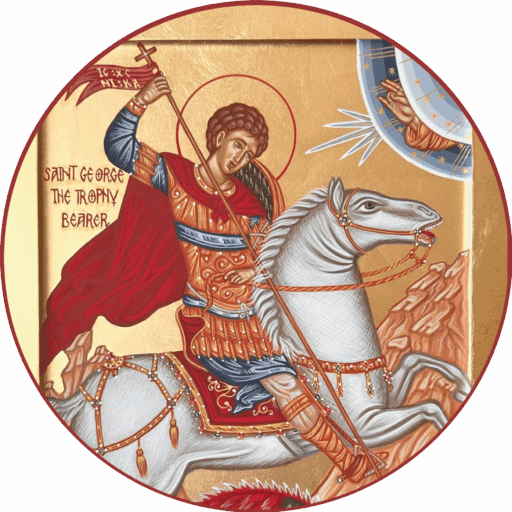


On Sunday October 26, 2025 The Orthodox Church celebrates the feast of the
Holy Great Martyr Dimitrios the Myrrh-streamer
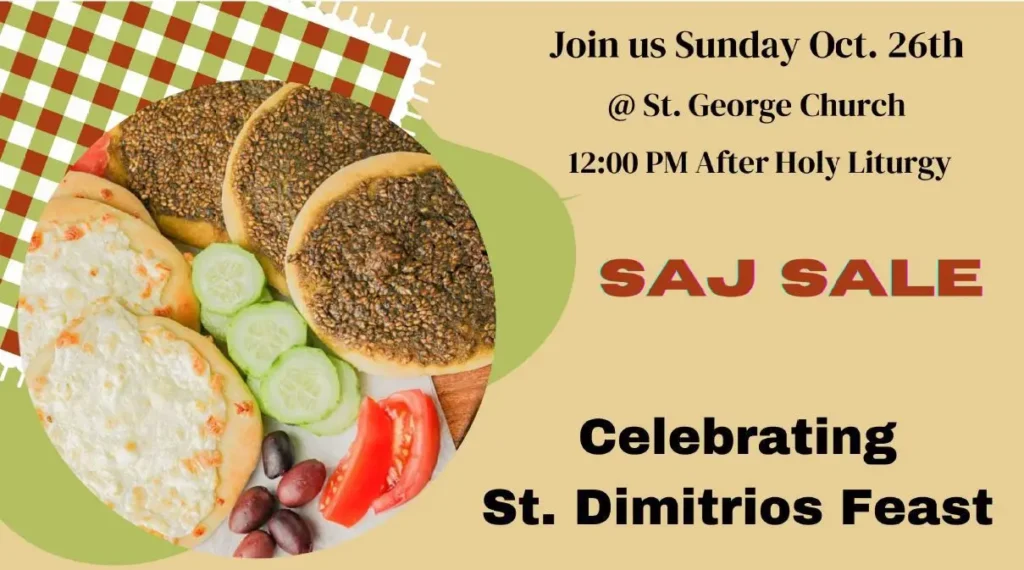
We will be celebrating Great Vespers on Saturday October 25th, with the breaking of the 5 loaves.
This feast is sponsored by the family of Ramzi & Sandy Battikha
They are sponsoring a Saj Sale for the benefit of St. George Church
St. Gregory Palamas writes:
For among martyrs he is as a great luminary among stars, holding forth the word of eternal life (Phil. 2:16)… From childhood he was all these things at once: a solid, immovable pillar of goodness, a breathing, moving image of every virtue; the shrine of divine and human graces, representing them all; a living book telling of glory and leading us to better things.
Life of the Saint Dimitrios
Saint Dimitrios suffered in Thessalonica during the reign of Galerius Maximian (c. 306). He belonged to one of the most distinguished families of the province of Macedonia and was widely admired not only because of his noble ancestry and grace of bearing, but also for virtue, wisdom and goodness of heart surpassing that of his elders.
The military expertise of Saint Dimitrios led Galerius, as Caesar of the Eastern Empire, to appoint him commander of the Roman forces in Thessaly and Proconsul for Hellas. But for all this, Dimitrios remained ever aware of the underlying realities of life. Since faith in Christ had touched his heart, all the glory of this world meant nothing to him, and there was nothing he preferred to teaching and preaching the word of God.
Despite the persecution directed against Christians by the Emperor, Saint Dimitrios brought a large number of pagans to the faith. His words convinced them because they saw in the righteousness, peace and brotherly love that marked his life an illustration of the truth of which he spoke.
The Emperor Maximian had just won a series of brilliant victories over the Scythians and was on his way back to Rome when he halted at Thessalonica to receive the acclamations of the populace and to offer sacrifices in thanksgiving to the idols. A number of pagans, envious of the success of the Saint, took advantage of the Emperor’s presence in the city to denounce Dimitrios as a Christian. Maximian’s astonishment gave way to violent indignation when he was told that Dimitrios’ was making use of his official position to spread the faith. Dimitrios was summoned and confined in a cell, located in the basement of nearby baths.
Maximian arranged for games and gladiatorial combats to take place in the amphitheater of the city. He had brought with him a man of gigantic stature and Herculean strength called Lyaios, a Vandal by origin. Such was this man’s strength and skill in single combat that no one could withstand him. There was in the city a young Christian called Nestor, who observing the empty pride of the Emperor in the victories of his champion, made up his mind to show him that real power belongs to Christ alone. He ran to the baths where Dimitrios was imprisoned and asked for the protection of his prayer in going to confront the giant. The Martyr made the sign of the Cross on the brow and the heart of the boy, and sent him like David before Goliath. He reached the amphitheater just as the heralds were crying out on all sides for any who would stand against Lyaios. Advancing towards the Emperor, Nestor threw his tunic to the ground and shouted, “God of Dimitrios, help me!” In the first encounter, at the very moment the giant rushed upon him, Nestor slipped aside and stabbed him to the heart with his dagger. There was uproar and amazement at the marvel, and people asked themselves how a mere child, relying neither on strength nor weapons, could so suddenly have brought down the barbarian.
Rather than yield to the sign of the sovereign power of God, the Emperor flew into a rage and ordered the immediate arrest of Nestor and his beheading outside the city. He had heard Nestor calling upon the God of Dimitrios and, supposing the Saint had used some kind of witchcraft, Maximian ordered his soldiers to go and thrust Dimitrios through with their lances, without trial, in the depths of his prison cell. There were some Christians, including Dimitrios’ servant Lupus, present at his martyrdom, and when the soldiers had gone, they reverently buried the Saint’s body.
It was God’s will that the grace with which He filled Saint Dimitrios should remain active even after his death. This is why He caused to flow from his body a myron with a delightful scent, which had the property of healing all who took it as an unction, with faith in the intercession of the Saint. Time and again, during sixteen hundred years, Saint Dimitrios has given proof of his benevolent care for the city of Thessalonica and its inhabitants. He has defended them from the attacks of barbarians, he has preserved them from plague and famine, healed the sick and comforted the afflicted.
Adapted from The Synaxarion: The Lives of the Saints of the Orthodox Church, Vol. 1, compiled by Hieromonk Makarios of Simonos Petra and translated from the French by Christopher Hookway (Chalkidike, Greece: Holy Convent of the Annunciation of Our Lady, 1998) pp. 481-483.